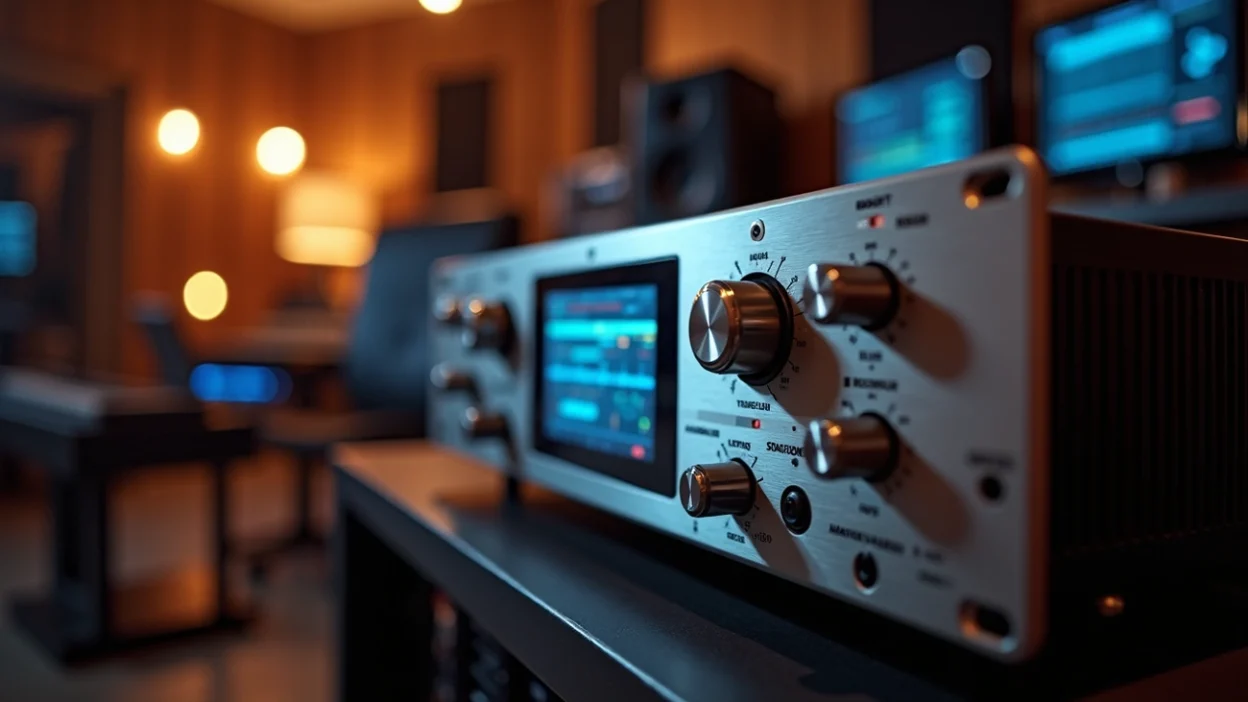
My first glimpse of the Bettermaker Limiter sparked immediate interest—it wasn’t just another piece of high-end gear, but a radical alteration in mastering technology. This impressive 2U rackmountable mastering limiter with its striking color screen brings something unique to today’s hybrid audio world.
The Bettermaker Mastering Limiter 2.0’s standout feature lies in how it blends analog processing with digital control. Its core circuitry relies on THAT Corporation 4031 chips—high-performance Blackmer VCAs with a fixed ratio of ∞:1 and up to 20dB of attenuation. The hardware boasts remarkable technical specifications that include 0.07% THD+N and a dynamic range of about 111dB. During my review of the Bettermaker Limiter plugin integration, I found that there was bi-directional communication that lets me adjust physical knobs on the hardware while watching parameters update live on screen. This capability has reshaped my workflow and allows me to switch between concurrent projects quickly.
This detailed Bettermaker Limiter review will show how version 2.0 builds on these foundations with new features that explain why many top engineers are making this choice.
Table of Contents
What Is the Bettermaker Limiter 2.0 and Who Is It For?

Image Source: Vintage King
The Bettermaker Mastering Limiter has been the go-to choice for Grammy-winning engineers worldwide for seven years. Version 2.0 takes this modern legend to new heights with more power, an easy-to-use interface, and richer features.
Analog Limiter with Digital Control
The Bettermaker Limiter 2.0’s heart is a 100% analog signal path that delivers the warmth audiophiles love. Notwithstanding that, its digital control and user interface make it stand out. This hybrid approach opens up possibilities you won’t find in standard analog limiters:
You can save and recall presets instantly
Your adjustments are precise and repeatable
A single control handles stereo operation with perfect channel linking
High-quality A/D conversion enables complete metering
Two high-speed 32-bit microcontrollers handle all control functions without touching the pristine analog audio path. You get the best of both worlds – analog sound quality paired with digital precision and ease of use.
Target Users: Mastering and Mixing Engineers
The Bettermaker Limiter 2.0’s signature sound shapes countless Billboard hits and festival anthems. Professional engineers love what it does. Many of the world’s biggest artists use it as their final processing stage.
This tool gives mastering engineers three key functions they need to craft perfect masters. Mixing engineers also swear by it – one user noted how the limiter “doesn’t soften and clamp down like software limiters”. The odd-order saturation helps kicks “punch through the mix like nothing else”.
The new design offers up to 20dB of gain reduction with improved path-to-signal uniformity. Engineers can create commercial-level masters without losing impact or dynamics.
Stereo and Mid-Side Processing Modes
The Bettermaker Limiter 2.0’s flexibility in signal processing topology sets it apart. True mid/side processing mode lets engineers work separately on the center and sides of a stereo image – a must-have feature in modern mastering.
The redesigned color section packs an MS matrix with two saturation modules that work together:
Color 1 creates odd harmonics
Color 2 produces even harmonics
You can internally EQ both color sections. This means different frequency ranges get different harmonic characteristics. To name just one example, you could add more odd harmonics in the low end while sweetening the highs with even harmonics. Hardware limiters rarely offer this level of tonal shaping.
The flexible link mode balances input and output level changes. This works great with mid/side operation. Users love the stereo expansion features, though one engineer wished “the unit had the capability to expand or close the mids in MS mode”. This suggests room for future improvements.
The Bettermaker Limiter 2.0 shows how far mastering technology has come. It combines analog hardware’s best qualities with digital control’s precision and recall. The result? The loudness, clarity, and character that define professional-grade masters.
Core Features of the Bettermaker Mastering Limiter
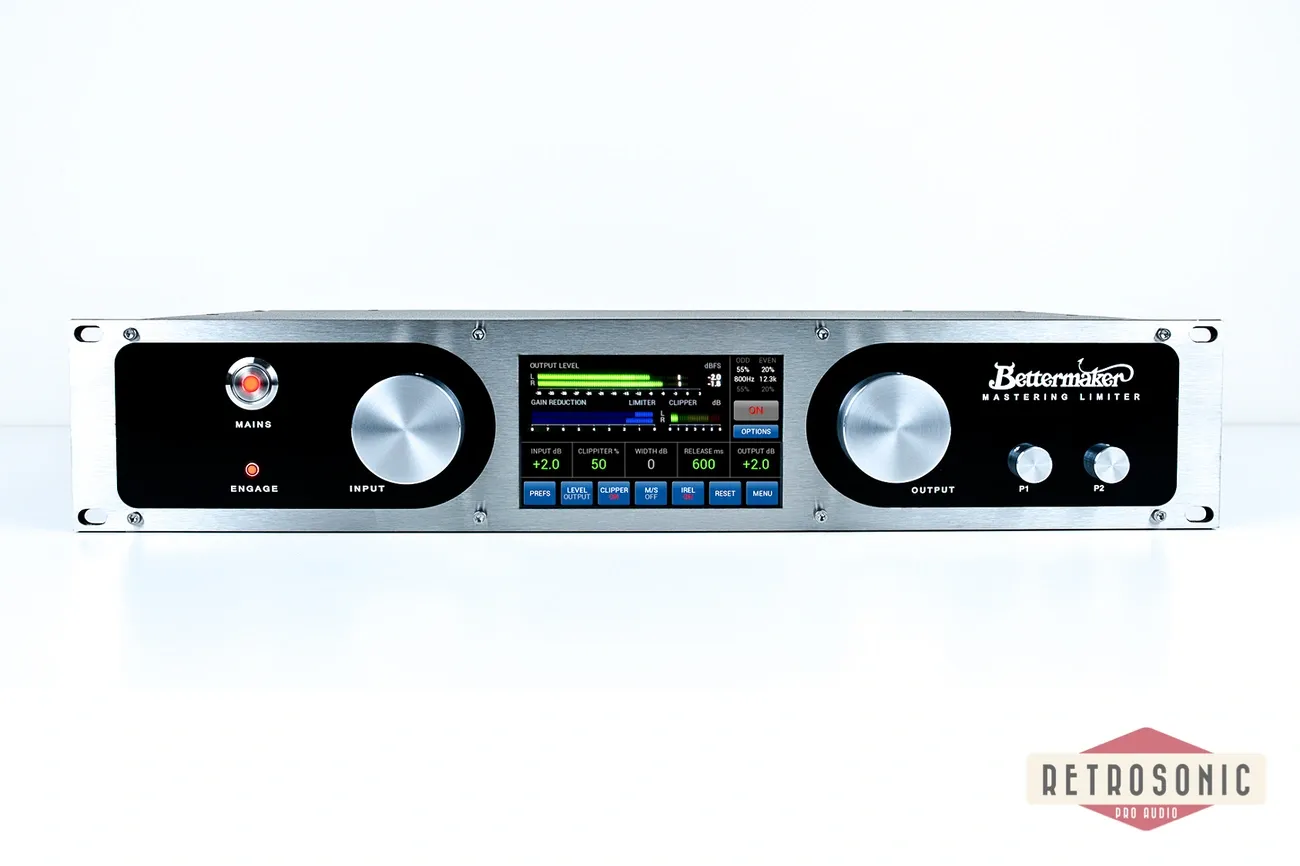
Image Source: Retrosonic Pro Audio
A look inside the Bettermaker Limiter 2.0 shows why audio professionals love this device. The sleek exterior houses a well-crafted signal chain that delivers both precision and character.
Limiter Architecture: VCA, Soft and Hard Clipping
The Bettermaker Limiter 2.0’s core is a high-performance analog VCA circuit that delivers up to 20dB of gain reduction. This limiter stands out with its fixed threshold design. More signal at the input creates more compression instead of needing threshold adjustments. The VCA section works as the main stage of dynamic control with an infinity-to-one (∞:1) ratio.
The completely redesigned dual-stage clipping section makes this unit special. The VCA and clipper thresholds are approximately 3dB apart. The clipper catches any transients that slip through the VCA stage because of attack time limits. The 2.0 version comes with high and low soft clip options and a dedicated soft clip trim control. Engineers can fine-tune the balance between limiting and clipping. This design keeps musical dynamics intact while ensuring exact peak control – the foundations of competitive masters that keep their impact.
Harmonic Color Section: Odd and Even Generators
The most creative part of the Bettermaker Limiter 2.0 might be its redesigned color section with MS matrix capabilities. The unit has two independent harmonic generators that work together:
Color 1 creates odd harmonics (3rd, 5th, 7th)
Color 2 focuses on even harmonics (2nd, 4th, 6th)
Each generator has adjustable drive parameters that shape harmonic character—from subtle warmth to aggressive distortion—and band-pass filters that target specific frequency ranges. This design creates remarkably musical saturation effects. You can add odd harmonics to low frequencies for extra punch while sweetening high frequencies with even harmonics.
These harmonic generators stayed musical even at extreme settings during testing. One user said, “the color section seems much smoother, even pretty extreme settings are retaining things/getting less grainy”. The unit works great for subtle mastering and creative mixing.
Touchscreen Interface and Preset Recall
The Bettermaker Limiter 2.0’s large color touchscreen interface with two rotary encoders catches your eye right away. The display shows horizontal bar-graphs for input/output levels, gain reduction meters, and clipper action.
Two high-speed 32-bit microcontrollers run the digital control system while the audio path stays completely analog. This hybrid design adds features you won’t find in traditional analog gear:
Instant parameter resets
Precise recall of 399 presets
Rapid, repeatable adjustments
Perfectly linked stereo operation
The screen gives you access to advanced metering options like FFT analysis, LUFS measurements, K-metering, and phase correlation. Engineers love seeing configurable analog-style VU meters right on the screen.
DAW Integration and Plugin Control
The Bettermaker Limiter 2.0 stands out with its advanced software integration capabilities. Audio engineers have struggled to connect hardware with modern DAW workflows, but Bettermaker’s user-friendly solution changes everything.
Plugin Formats: VST, AU, AAX Compatibility
The Bettermaker Mastering Limiter 2.0 comes with a brand-new plugin for all major digital audio workstation platforms. This software works as a control surface and bridge between your DAW and hardware unit. The complete format support impressed me right away with:
VST2/VST3 for Windows and Mac users
Audio Units (AU) for Logic Pro and other Mac-based DAWs
AAX for Pro Tools integration
You won’t face platform-specific limitations that affect most hardware controllers. The plugin installs easily, and Bettermaker’s website offers quick access to firmware and plugin updates.
Real-Time Bi-Directional Control
The plugin integration’s most impressive feature is its bidirectional communication system. The Bettermaker Limiter 2.0 uses USB to connect as a Human Interface Device (HID). Any parameter changes on the hardware update the plugin interface immediately, and it works both ways.
This bidirectional control proved valuable during my testing sessions. It helped me focus on the sound instead of staring at screens during critical listening. The hardware unit works perfectly even without the plugin, so you retain the pure analog workflow when needed.
Automation and Recall in DAW Projects
The Bettermaker Limiter 2.0’s DAW integration solves a major limitation of analog gear – parameter recall and automation. The plugin supports full automation and recall features on all major platforms.
This unit bridges analog warmth with digital convenience perfectly. Saving processor settings in project files helps immensely with mastering sessions across musical genres. The unit becomes part of your DAW while keeping its 100% analog signal path.
Mastering engineers working on multiple projects will love the improved workflow efficiency. The USB connection creates a smooth experience as the hardware functions as an HID device through the dedicated Bettermaker Mastering Limiter Plugin.
Advanced Metering and Monitoring Tools
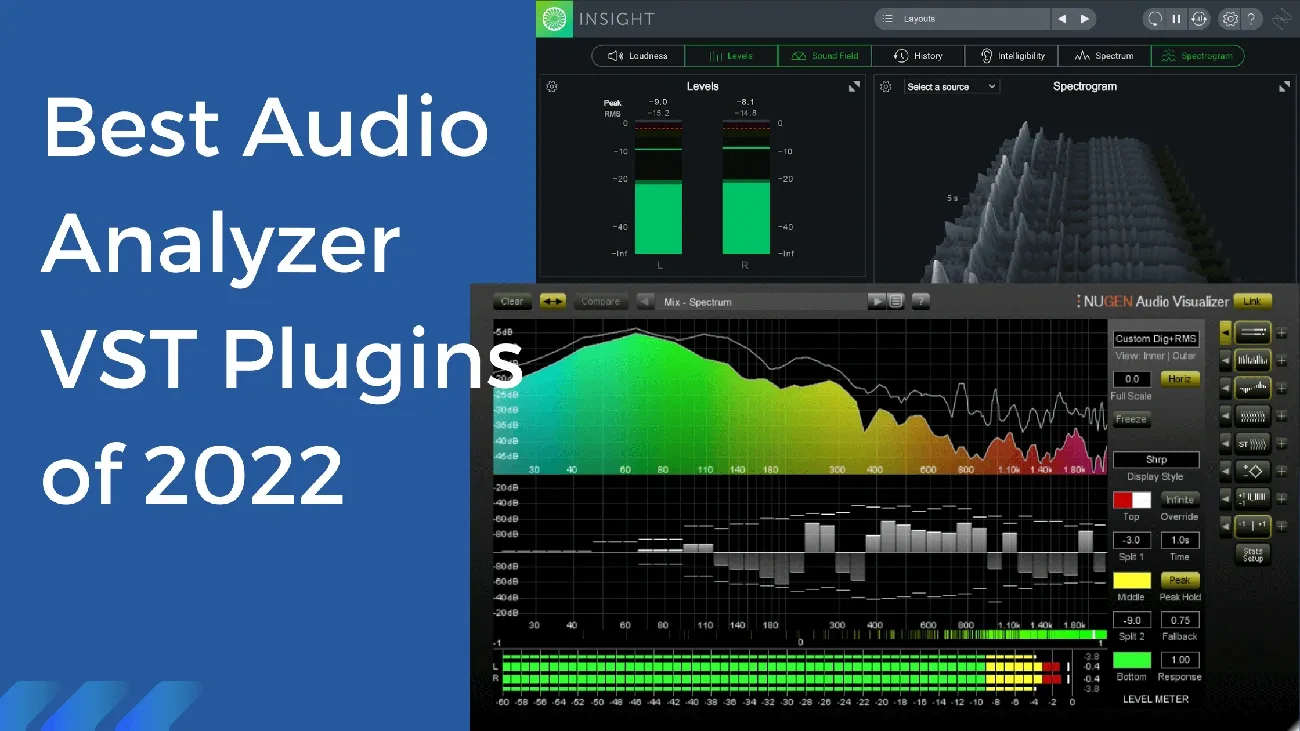
Image Source: Rocket Powered Sound
The Bettermaker Limiter 2.0 goes beyond impressive limiting. Its extensive metering tools match dedicated analysis devices. The visualization options make this unit both a processing powerhouse and a detailed monitoring station.
Input/Output Metering and Gain Reduction
The touchscreen display serves as a monitoring hub that has horizontal bar-graphs spanning from -36 to +3 dBFS for precise level monitoring. A dedicated blue meter shows gain reduction across an 8dB range, while a separate bar-graph displays clipper action through a 6dB range.
The unit has four analog-style meter simulations: PPM, two VU meter styles, and a digital dBFS moving-coil meter. Each meter’s ballistics suit specific monitoring needs—from Type 1 PPM’s 5ms integration time to the VU meters’ 300ms response. The unit can handle maximum gain reduction of 20dB. Input adjustment ranges from 0 to +20dB, and output adjust spans -10 to +12dB.
Spectrum Analyzer and K-Metering
The spectrum analyzer shows frequency content two ways: a 30-band FFT visualization with peak hold or a graph with movable frequency cursor. The loudness monitoring features LUFS measurements (Short term, Integral, and Loudness Range) with time-based visualization.
Bob Katz’s K-metering system comes built-in, supporting K-12, K-14, and K-20 standards. This system helps engineers maintain consistent monitoring levels while preserving dynamic range—a vital aspect of modern mastering.
Phase Correlation and FFT Display
The goniometer and correlation meter are a great way to get stereo image analysis, letting engineers verify mono compatibility. Engineers can switch between different fade timeouts for the correlation graph and reset it when needed.
The metering system measures both input and output signals, giving mastering engineers clear insight throughout their signal chain. The unit ended up eliminating the need for extra metering plugins or hardware. The Bettermaker Limiter 2.0 delivers a complete mastering solution that meets professional-grade loudness standards, including EBU R128 and ITU-R BS.1770 recommendations.
Real-World Performance and Use Cases
My experience with the Bettermaker Limiter 2.0 in real-life production showed its value goes beyond mere specs. This device shines in ground applications where standard hardware limiters struggle to perform.
Mixing and Mastering Workflow Integration
The unit makes setting precise input levels and attack times feel natural. You can control peaks accurately without any guesswork. The intelligent release mode (“Irel”) handles most material exceptionally well. Manual release settings sometimes yield better results. The high-pass filter sidechain (20-200Hz) and mid-boost filter (8dB at either 2kHz or 7kHz) offer subtle volume control that analog limiters never had before.
Professional engineers now consider the Bettermaker their essential gear for adding dynamic edge in final processing. It stays influential unlike software alternatives that can flatten mixes with their characteristic “clamping down” effect.
Color and Saturation in Hybrid Setups
The color section stands out as the Bettermaker’s most impressive feature. The dual-module saturation system gives you amazing tonal flexibility through:
Color 1 module generates primarily odd harmonics for added bite
Color 2 focuses on even harmonics for smoother sweetening
Engineers love how the clarity stays intact even at extreme settings. The saturation adds weight through subtle “browning” of tone while staying musical. You can target specific spectral regions for harmonic generation, creating powerful creative options that almost justify the cost alone.
Handling Transients and Loudness Maximization
The new clipper section handles transients with expertise through high/low soft clip options and trim control. This design combines with faster release times and a lower noise floor to make the Bettermaker 2.0 perfect for competitive loudness that stays musical.
AAA project engineers value its transparent safety limiting. The Bettermaker excels at keeping loudness while preserving dynamic impact. You can use it subtly for mastering or push it harder when you want to consider color.
Conclusion
My extended time with the Bettermaker Limiter 2.0 has made one thing crystal clear—this device marks a major progress in mastering technology. Very few competitors can match how it blends analog processing with digital control.
This unit shines with its versatility, thanks to VCA limiting, dual-stage clipping, and its musical harmonic color section. The color modules keep things clear even under pressure, which lets you shape your sound creatively without the harsh edge you’d typically get from digital options.
The plugin integration works both ways and it changed my workflow completely. I can tweak hardware settings and watch my DAW update instantly, which breaks down the usual walls between analog processing and digital production. This feature saves hours of work across multiple projects.
On top of that, the metering tools deserve a special mention. You’d normally need separate gear for what this unit offers—spectrum analyzer, LUFS measurements, and phase correlation display all provide vital visual feedback.
Notwithstanding that, the Bettermaker’s premium price tag needs serious thought. The value makes more sense when you compare it to buying separate analog hardware and metering solutions.
Without doubt, this unit works best in professional mastering setups where clean limiting, harmonic enhancement, and exact recall are must-haves. No standard analog limiter can match its ability to apply different harmonic characteristics to specific frequency ranges.
The Bettermaker Limiter 2.0 gets my full endorsement for professional engineers who want the ultimate finishing tool. This device will shape countless hit records in the years ahead—just as it will in my studio.